You’ve graduated, or you have your latest semester results in hand. You are staring at a CGPA (Cumulative Grade Point Average) like 8.4 or 9.2. You feel good about it. But then, you open a job application portal or an IIM admission form, and it asks for one specific thing: Percentage.
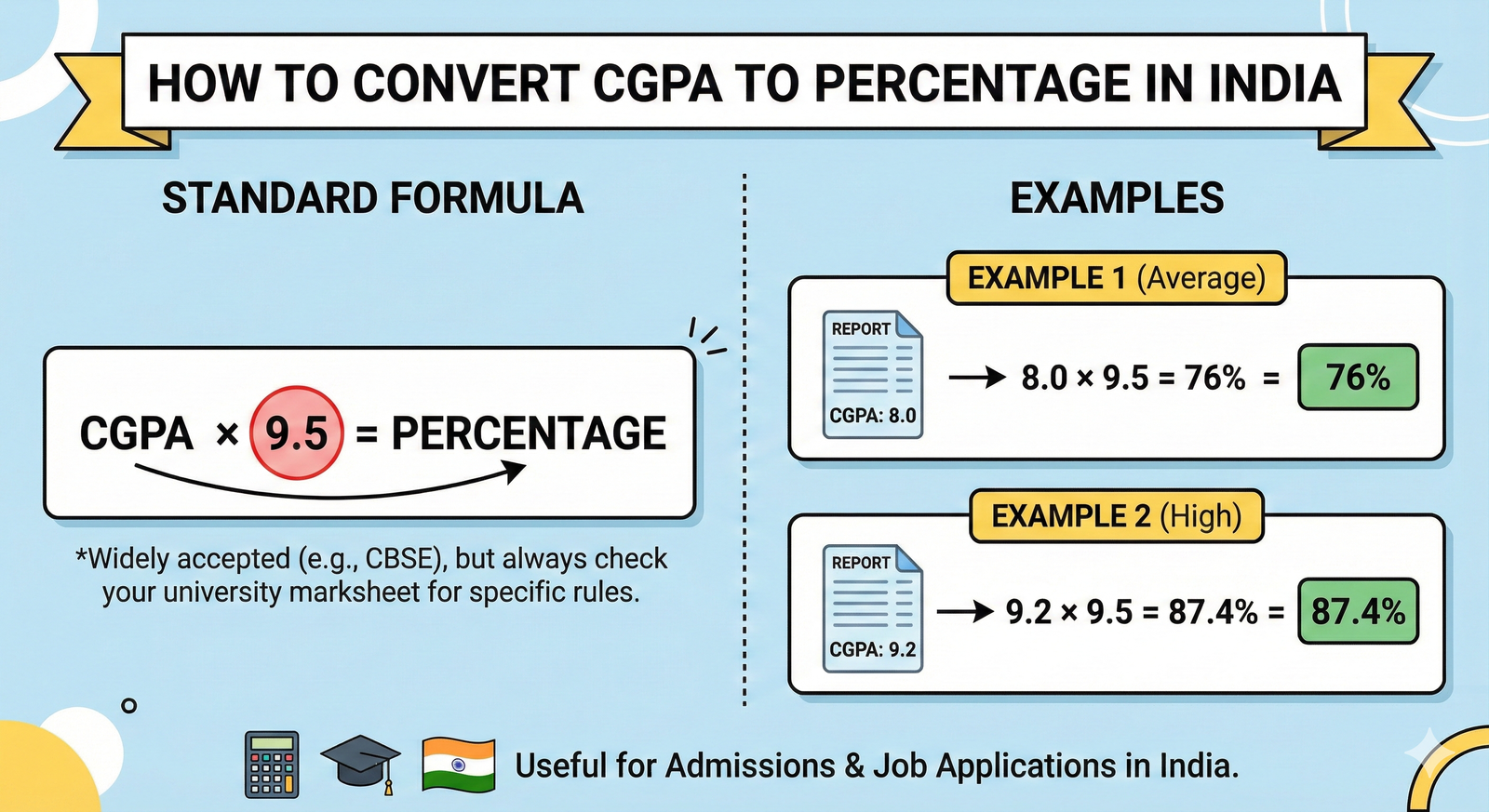
Confusion sets in. Do you multiply by 9.5? Do you multiply by 10? Do you use a complex equation?
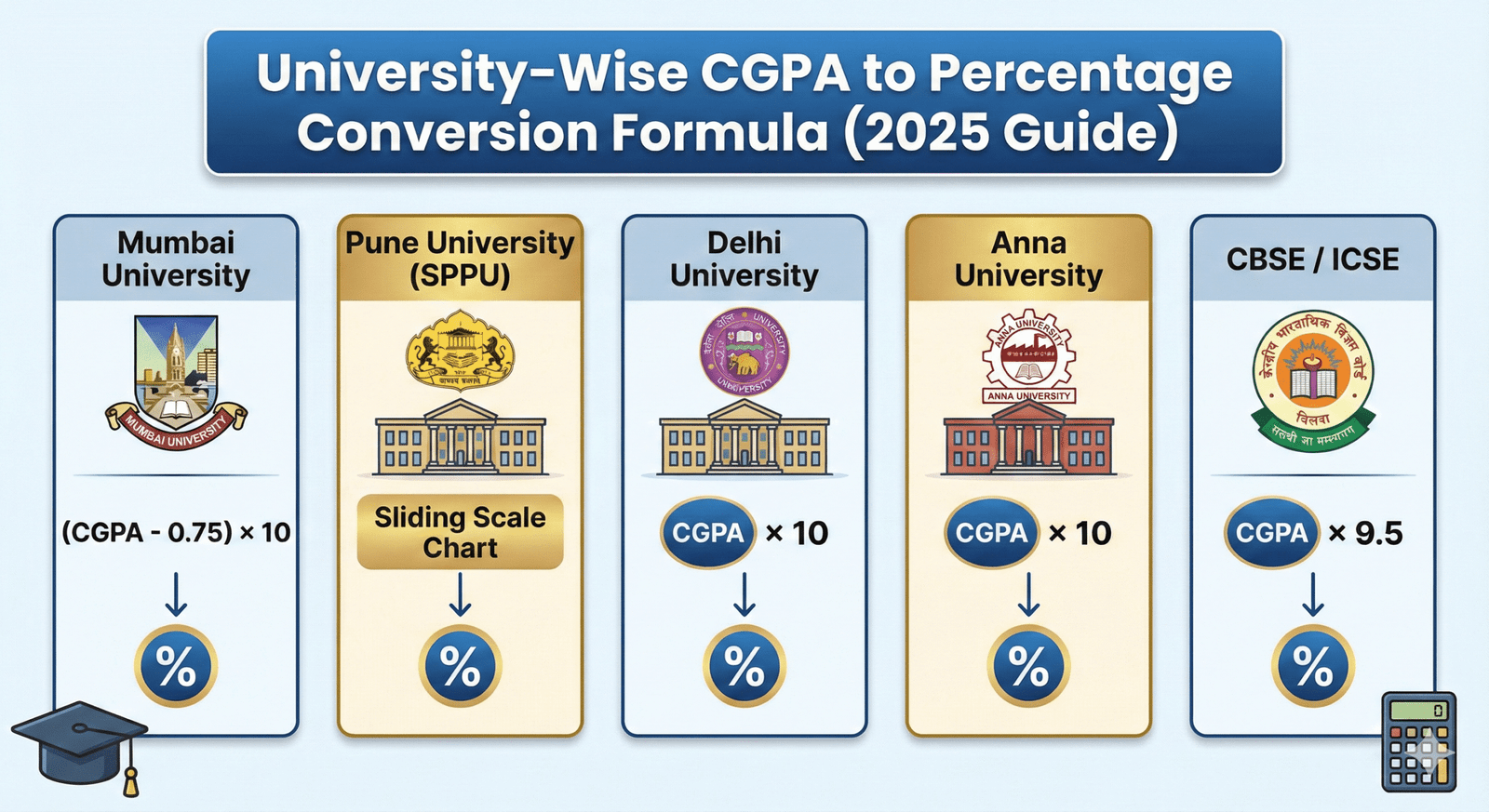
In India, the biggest mistake students make is assuming one formula fits all. It doesn’t. Using the wrong multiplier can significantly increase or decrease your actual score on paper. This guide will provide the exact university-wise CGPA to percentage conversion formulas updated for 2025 for major Indian institutions.
1. Mumbai University CGPA to Percentage Formula
Mumbai University (MU) has notoriously confusing grading systems that have changed several times over the last decade (from 7-point scales to 10-point scales). The CGPA to percentage Mumbai University calculation often depends on your specific stream (Engineering vs. Arts/Commerce) and your admission year.
For Engineering and Technology (Recent Batches):
Under the recent Choice Based Credit System (CBCS) for engineering, the formula has been simplified compared to older schemes.
Calculation: (8.25 – 0.75) = 7.5
7.5 × 10 = 75%
Note: Some very recent MU circulars for specific courses may suggest a direct multiplication by 10. Please verify with your college administration.
2. Pune University (SPPU) CGPA Conversion
Savitribai Phule Pune University (SPPU) does not use a single multiplier. The SPPU CGPA conversion utilizes a “sliding scale” formula based on the range in which your CGPA falls. This is applicable for the 2015 and 2019 credit patterns.
SPPU Grading System Table:
| If Your CGPA is in Range: | Use This Formula to Calculate Percentage: |
|---|---|
| O Grade (9.50 – 10.00) | Percentage = 20 × CGPA – 100 |
| A+ Grade (8.50 – 9.49) | Percentage = 12 × CGPA – 25 |
| A Grade (7.50 – 8.49) | Percentage = 10 × CGPA – 7.5 |
| B+ Grade (6.50 – 7.49) | Percentage = 5 × CGPA + 26.25 |
| B Grade (5.50 – 6.49) | Percentage = 10 × CGPA – 2.5 |
| C Grade (4.25 – 5.49) | Percentage = 10 × CGPA – 2.5 |
This falls in the “A Grade” range (7.50 – 8.49).
Formula: 10 × CGPA – 7.5
Calculation: (10 × 8.0) – 7.5 = 80 – 7.5 = 72.5%
3. Delhi University (DU) CGPA Conversion
For a long time, Delhi University used the “9.5 multiplier” rule, similar to CBSE. However, under the recent CBCS (Choice Based Credit System) and NEP frameworks, DU has simplified the process significantly.
This is one of the easiest conversions. If you secured a 7.8 CGPA at DU, your percentage is simply 78%.
4. Anna University CGPA to Percentage
Anna University, a major hub for engineering students in South India, also follows a straightforward approach for its recent regulations (e.g., Regulation 2017 onwards).
5. CBSE and ICSE Boards (Class 10 & 12)
While universities are moving towards the x10 multiplier, school boards often stick to older statistical methods.
CBSE (Central Board of Secondary Education)
CBSE is famous for popularizing the “9.5 factor”. Though CBSE has moved back toward mentioning marks in recent years, many students still have CGPA based marksheets or need to convert Grade Points.
Why 9.5? Statistically, the average score of the top band of students was found to be closer to 95% than 100%.
ICSE / ISC
ICSE usually provides direct marks alongside grades. To calculate the percentage, you typically take the average of your best 5 subjects (including English), depending on the specific requirements of the college you are applying to.
Why You Can’t Just Use a Google Calculator
If a student from Pune University with an 8.0 CGPA uses a generic “times 10” calculator found online, they will think they have 80%. In reality, based on the SPPU formula, they have 72.5%. That is a massive 7.5% difference that could cost them a job eligibility or a university seat.
Always rely on the official formulas provided by your specific institution.
Conclusion
Navigating the CGPA to percentage conversion landscape in India can be tricky because every university has autonomy. While many are moving towards the simpler “× 10” rule, major institutions like Mumbai University and SPPU still use unique formulas. Bookmark this 2025 guide to ensure you are always calculating your scores accurately.
Frequently Asked Questions (FAQs)
Q: What is the universal formula for CGPA to percentage?
There is no universal formula. The most common ones are multiplying by 9.5 (CBSE standard) or multiplying by 10 (many modern technical universities).
Q: How do I convert CGPA to percentage if my university formula is not listed here?
Check the back of your official marksheet or transcript. It is almost always printed there in fine print. If not, contact your university’s examination department.
Q: Is 10 CGPA equal to 100%?
Usually, no. In systems using the 9.5 multiplier, 10 CGPA equals 95%. In systems using the x10 multiplier, it technically equals 100%, but universities often cap the maximum percentage at an arbitrary number like 99% or 95%.